Adancing Arts Education Through the Every Student Succeeds Act
How Does Arts Education Fare in the Final Round of State ESSA Plan Submissions?

This guest post comes from Lynn Tuttle, director of public policy and professional development at the National Association for Music Teaching (an Arts Didactics Partnership partner organization).
In the commencement circular of country plans submitted nether the Every Pupil Succeeds Act (ESSA) final bound, 60 percent (eight states) included arts within key areas of their state accountability systems. In the 2d set of state plans, arts education continues to be plant, although in a larger variety of places and spaces. Following is an analysis of where and how states included arts education in this second circular.
20-ix percent (11 states) of new land plans acknowledge arts educational activity inside accountability systems, which means 35 percent of all plans accost access and participation rates in arts education as office of state accountability and/or reporting systems.
Many of u.s. are conservative in their accountability system designs, keeping their reporting systems focused on the No Kid Left Backside indicators of reading and math. Nonetheless, v boosted states embrace arts indicators in their accountability systems: Georgia, Kentucky, Maryland, Minnesota and Wyoming. While Kentucky has worked with arts education indicators as role of its state monitoring of schools for several years, this is a new lift for the other four states. Maryland, Minnesota and Wyoming focus on access to arts classes, every bit well as participation rates for students in arts classes. Georgia is looking not just at admission, only as well measures of student performance in selected fine arts classes at the uncomplicated and heart school levels.
Forth with these five states, New Hampshire, Arizona, Oregon and Due south Dakota as well include the arts in various sections and innovative ways in their accountability systems.
In add-on, New York and Ohio are convening stakeholders from the arts pedagogy community to determine how to include arts indicators in the future.
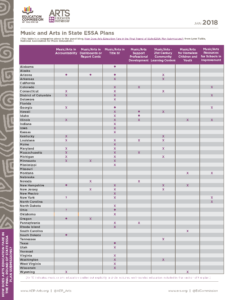
More highlights from the 2nd circular of submissions:
- Fifty-five percent of state plans (19 states) include arts pedagogy within Title IV, Role A, bringing the full to 70 percent of states that identify the arts in this program or describe the overall importance of a well-rounded education.
- Twenty-four percent (nine states) of state plans (and 22 percent of all state plans) brand explicit the country's support for arts education in Title I schools or in school improvement schools.
- Eighteen per centum (7 states) of state plans specifically call out arts education equally supported through the after-school 21st Century Customs Learning Centers plan, bringing the total to 24 pct of all state plans.
Arts education appears in a broad range of boosted programs, from support of migrant children to rural and depression-income schoolhouse funding options.
As in the first round of plans, states include arts educational activity in a variety of ESSA-funded programs in the 2nd round of submissions, showing that access to and participation in music and arts is expected to be available for all students. These programs include supports for:
- Homeless children and youth.Several states, such as Missouri, Rhode Island and New Hampshire, include language about breaking down barriers to children's participation in arts activities if the children were identified as homeless.
- Migrant children.Two states (California and New York) include language about ensuring students identified as migrant children have access to arts educational activity. Migrant children are identified as children who move schools throughout the school yr in order to be with families who migrate for work, such as farm workers.
- Neglected and delinquent children.Utah's plan mentions the need for students identified as neglected and runaway (including those returning to public schools afterward being in detention) to have access to arts education.
- Rural and low-income schools.Two states (Missouri and New York) mentioned arts education in their state plans in regards to rural and low-income schools. Like supports for migrant children and neglected and delinquent children, these programs receive dissever funding under ESSA to support schools with extreme poverty and/or located in isolated, rural areas.
Source: https://ednote.ecs.org/how-does-arts-education-fare-in-the-final-round-of-state-essa-plan-submissions/
0 Response to "Adancing Arts Education Through the Every Student Succeeds Act"
Post a Comment